
Leak diagnosis that follows the water
We trace likely entry points like parapet cap flashing, wall transitions, seams, and penetrations, not just the interior stain. Flat-roof leaks often travel before they show up inside.
Serving Miami, Florida & surrounding areas
Mon–Fri 8am–6pm · Sat 9am–2pm
Flat roofing in Miami, Florida
Installation, repairs, and maintenance for residential and commercial flat roofs built for South Florida sun, rain, and wind. Get a clear scope, photos of what we find, and fast scheduling from a licensed local team.
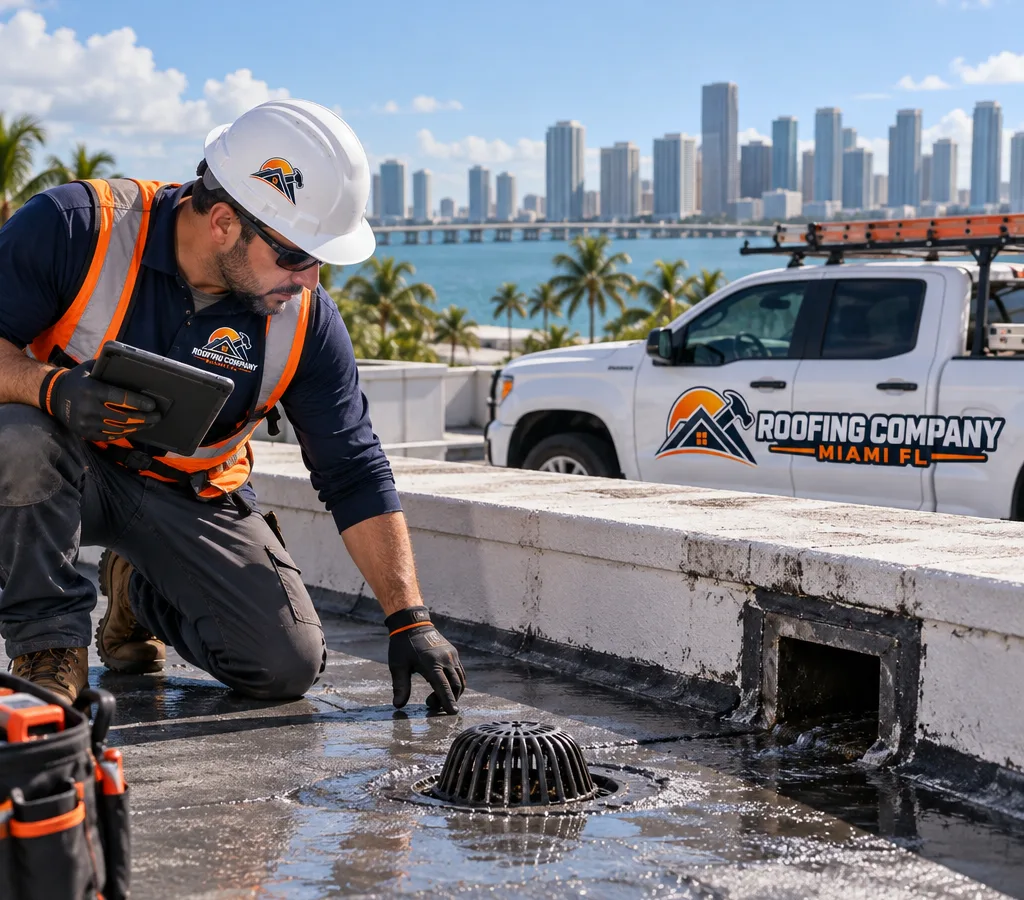
Low-slope performance
If you are searching for flat roofing Miami service, you are usually dealing with one of three problems: water that does not drain fast enough, a membrane that is aging or damaged, or flashing details that are letting water into parapet walls and penetrations.
Miami adds its own pressure to flat roofs. Intense UV exposure speeds up surface wear, sudden downpours test drainage immediately, and wind events punish edges, terminations, and rooftop equipment curbs. On a flat or low-slope roof, the details do most of the work: drains and scuppers, the slope toward them, seam integrity, and the transitions at walls, skylights, vents, and HVAC stands.
Roofing Company Miami FL focuses on practical, inspectable solutions: identify the leak path, document what is happening, recommend the right repair or replacement scope, and build the roof so it drains and stays watertight. If you also need a broader evaluation of the building envelope and roof condition, start with a local roofing contractor visit that includes photos and a written plan.
Roof-system options
Most flat roofs in Miami fall into a few proven categories. The right choice depends on your roof's condition, how it drains, foot traffic, and how many penetrations you have.
Modified bitumen (torch-down or self-adhered): A tough, layered system that handles foot traffic well. It is often chosen for residential flat roofs and smaller commercial buildings where durability and patchability matter.
TPO (thermoplastic polyolefin): A single-ply membrane with heat-welded seams. It is common on commercial low-slope roofs and works well when details and weld quality are done correctly.
Silicone or acrylic roof coatings: Used to extend the life of an existing roof that is still structurally sound. Coatings are not a cure-all; they require proper prep, repairs, and compatible substrates.
We will explain what is on your roof now and why it is failing, then recommend the smallest scope that solves the problem, or a full replacement when repairs stop being cost-effective.
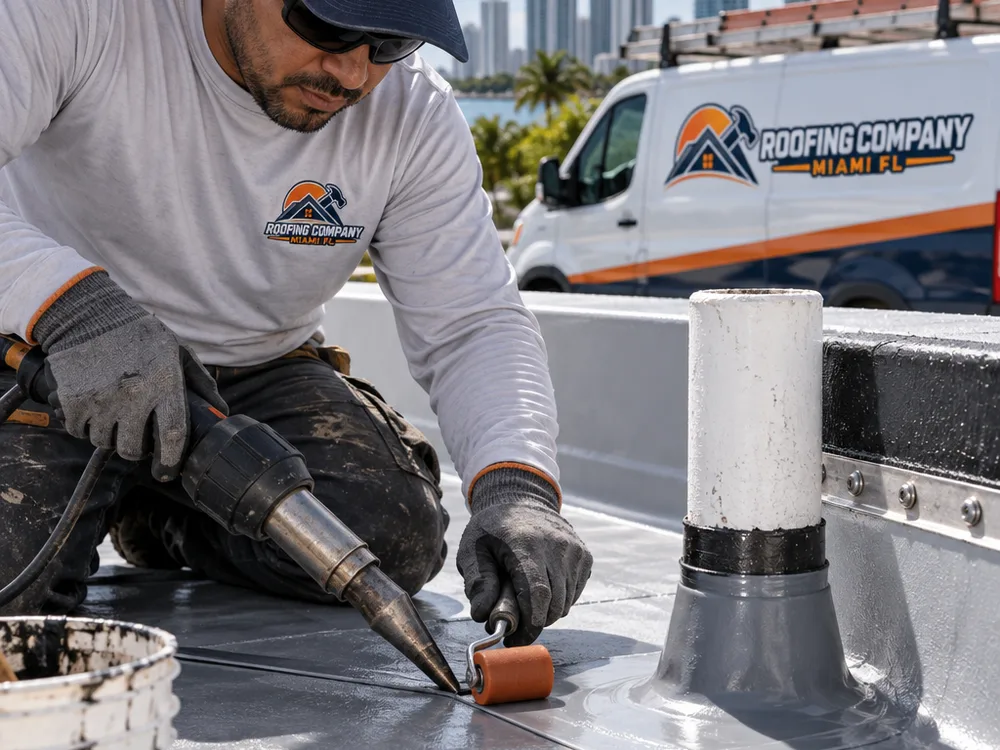
Complete flat-roof service
We trace likely entry points like parapet cap flashing, wall transitions, seams, and penetrations, not just the interior stain. Flat-roof leaks often travel before they show up inside.
Low-slope roofs depend on moving water off the surface. We check for clogged drains, inadequate slope, and ponding areas that shorten membrane life.
A repair has to be compatible with your existing membrane and detailing method. We avoid mismatched materials that peel, crack, or fail at the seam line.
Wind finds weak edges first. We focus on term bars, coping, and transitions where uplift and movement concentrate.
You get a written scope and straightforward options: repair, restore, or replace. Photos help you see the exact areas driving the recommendation.
From homes with flat roof sections to retail and small commercial buildings, we plan around access, noise sensitivity, and occupant safety.
Miami failure points
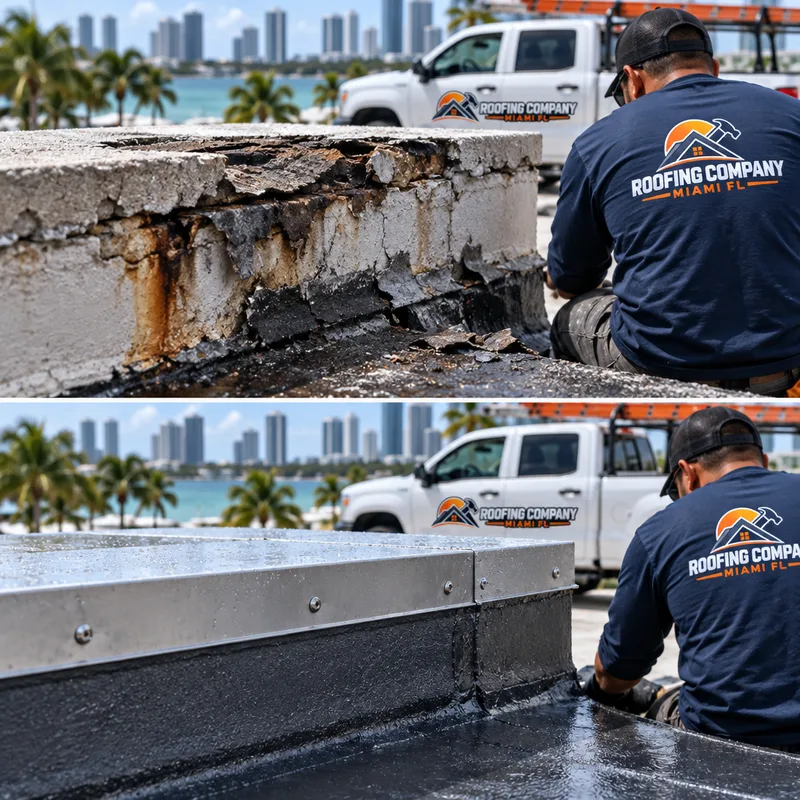
Flat roofs rarely fail in the middle of an open field of membrane. Most issues start at transitions and terminations.
CALL NOW (786) 981-8808Water can enter at coping seams, fastener points, or where flashing turns up the wall. Once inside the wall, leaks can appear far from the roof edge.
Vents, conduit, and equipment curbs move with heat and wind. If the flashing detail is brittle, loose, or incompatible with the membrane, it becomes a repeat leak.
On single-ply systems, seam integrity is everything. On modified bitumen, laps and cap-sheet details matter. A blocked drain can turn a fast storm into standing water that backs up into weak details.
Multiple layers of mastic and random patches can hide the real problem and make future repairs harder. We remove what needs removing, then rebuild the detail correctly.
In Brickell and Downtown, roof access and staging often matter as much as the repair itself. In Coral Gables, complex parapet and architectural transitions need extra attention. Along Miami Beach, salt air accelerates corrosion at metal edges and fasteners, making terminations and coping a priority.
Inspection to closeout
Step 1 of 5
We inspect the surface, seams, terminations, drains, and penetrations, then compare those findings to where you are seeing staining or bubbling. We document the likely entry points with photos.
Step 2 of 5
You receive a clear scope for the recommended repair or replacement, plus alternative options when they make sense, such as a targeted repair versus a restoration approach.
Step 3 of 5
Flat roofs succeed at the details: cleaning, drying, proper primers, compatible adhesives or welds, and rebuilding flashing transitions before large field areas.
Step 4 of 5
We complete the system-specific work—patch, weld, adhere, or torch where appropriate—then address edges, parapets, and penetration boots to match the roof type.
Step 5 of 5
We verify water paths to drains and scuppers, seal and finish terminations, and leave the roof clean. You get a final walk-through with the key areas we addressed.
Planning your flat-roof budget
Flat roofing in Miami typically ranges from about $8 to $18 per square foot for replacement, depending on the system—modified bitumen, TPO, or a restoration approach—roof access, and how much flashing and insulation work is needed. Small targeted repairs often start around $350 to $1,500+, while larger leak-chasing or multiple-detail repairs can run higher when drains, parapet coping, or many penetrations are involved.
Final price depends on roof size, current layers, moisture-damaged decking, edge details, drainage corrections, and permitting requirements where applicable. The exact cost is confirmed after an onsite inspection and a written scope.
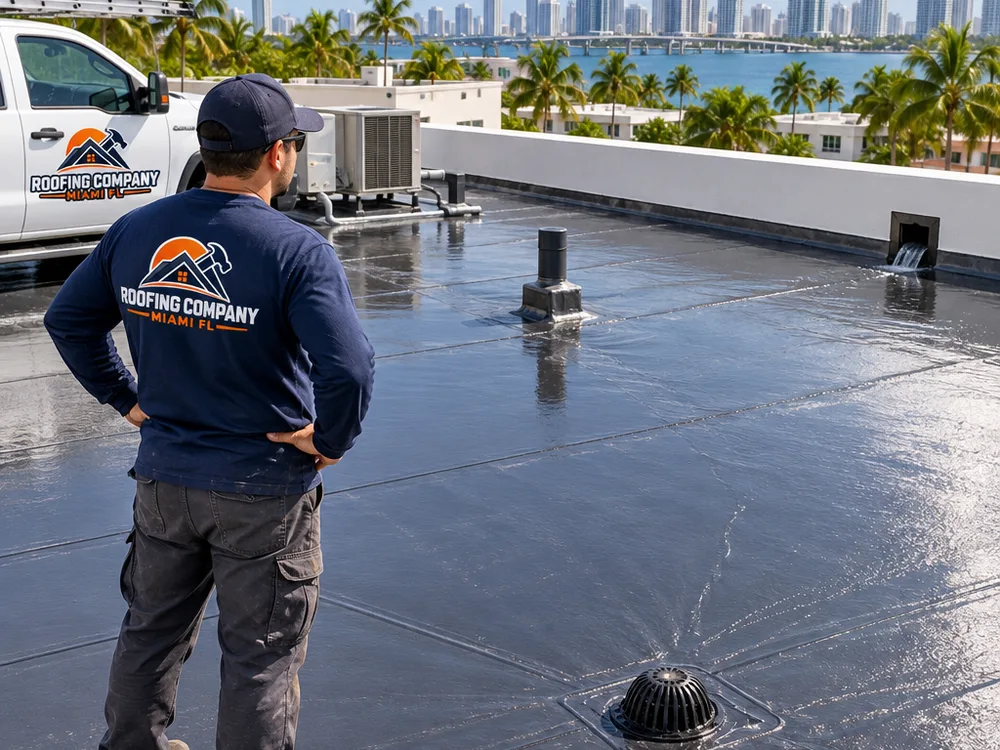
Flat-roof details you can see
Answers before work begins
If leaks are isolated to a few details—one penetration, one seam line, or a small flashing break—a repair is often enough. If you have widespread seam failures, recurring leaks in different areas, or saturated insulation or decking, replacement is usually the better long-term scope. Onsite inspection is the only reliable way to tell because water can travel under a membrane before it shows inside.
Yes, but the fix depends on the cause: clogged drains or scuppers need cleaning and correction, while low areas may require re-sloping with tapered insulation or a compatible build-up before the membrane work. In Miami, ponding shows up fast after heavy rain, so drainage corrections are often part of a lasting flat-roof repair.
A properly installed system matters more than the label on the roll, but Miami's UV and storm cycles reward strong seams, reliable flashing details, and durable edges. Modified bitumen and heat-welded single-ply systems like TPO are common choices, and coatings can be a good option when the existing roof is still sound and prepared correctly.
Many flat roof repairs can be completed in a single visit, while multi-area leak work or flashing rebuilds may take 2 to 3 days depending on access, drying conditions, and material cure times. We will confirm the schedule after inspection once we know how much of the roof needs preparation and detail work.
No, a flat roof that drains correctly and has intact seams and flashing should stay watertight even in a downpour. When leaks show up only during heavy rain in Miami, the cause is often a transition detail, a backed-up drain, or wind-driven water getting under a weak edge or coping seam.
Yes, we handle both residential and commercial flat roofing in Miami, and we plan the work around access, safety, and occupant needs. For commercial properties, we also pay special attention to rooftop equipment curbs and the penetration count, since those details drive both performance and repair complexity.
Start with a documented inspection
Tell us what you are seeing—leak location, ponding areas, age of the roof, and any prior repairs. We will inspect the roof, document the problem areas, and provide a written scope that fits your building and budget.